Monday, October 24, 2016


Over 80 NGOs call for Russia to be dropped from UN rights council over Syria
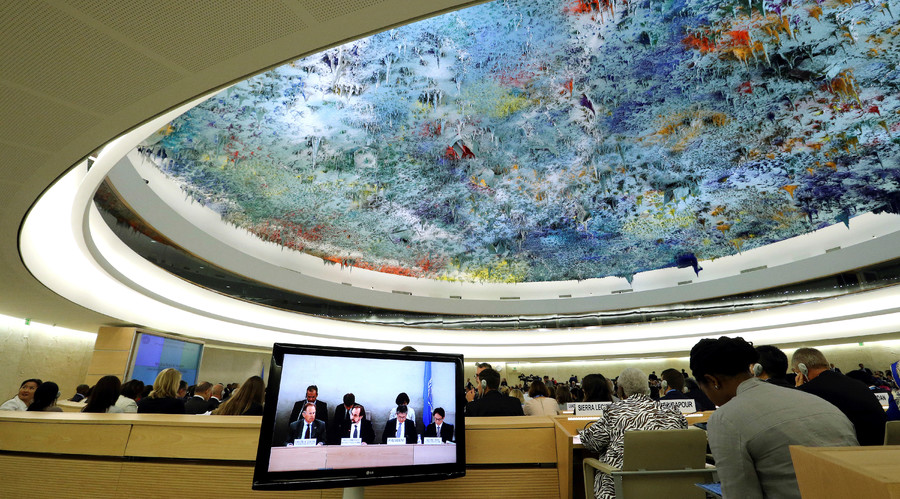
A number of human rights and aid organizations have urged the United Nations to deprive Russia of its seat on the UN's Human Rights Council (UNHRC), AFP reported on Monday.
More than 80 international organizations have signed the appeal, with such groups as Human Rights Watch, CARE International and Refugees International among them, AFP says.
The move was prompted by Russia's involvement in the anti-terrorist campaign in Syria.
The signatories asked the UN member states to "question seriously whether Russia's role in Syria which includes supporting and undertaking military actions which have routinely targeted civilians and civilian objects renders it fit to serve on the UN's premier inter-governmental human rights institution," AFP reports, citing the text of the appeal.
The appeal has been submitted ahead of elections to the UN's human rights body that are scheduled for Friday. The UN General Assembly in New York will be selecting members to fill 14 seats, with Russia, Hungary and Croatia running for two seats representing the Eastern European group at the council.
Saudi Arabia, China, Iraq, Brazil, Cuba, Egypt and South Africa are among the other countries vying for seats in various regional groups. The US and UK are seeking election to the two seats representing the Western Europe and Others group. Elected nations will be represented in the 47-nation council for three years, starting from 2017.
Russia is currently in the UNHRC, but its membership expires this year.
Last week, Britain and its Western and Arab allies introduced a resolution to the UNHRC demanding a review into alleged human rights violations in the Syrian city of Aleppo. The council then voted to start an independent special inquiry into the situation in the war-ravaged city.
Russia has been assisting the Syrian Army in fighting Al-Nusra Front terrorists in eastern Aleppo, which has become the militants' stronghold in Syria. However, the West has blamed Moscow and Damascus for most of the civilian casualties in the area.
Russian Foreign Ministry spokeswoman Maria Zakharova has called the resolution's accusations "cynical" and "dishonorable."
The fighting has divided the city of Aleppo into two parts, with its western districts currently under government control and eastern parts held by rebels and Al-Nusra Front fighters. Although the militants have constantly attacked western Aleppo, resulting in numerous civilian deaths, last week Russia and Syria initiated a humanitarian ceasefire, giving people a chance to flee the battle scene.
But despite the hopes, civilians have not been able to leave the militant-held eastern Aleppo for days, with terrorists constantly bombing humanitarian corridors. The UN and other aid groups which were supposed to bring humanitarian aid through the corridors were unable to do so because of security concerns.
Investigative journalist Willy Van Damme, who has been closely following the Syrian conflict, told RT he was not surprised by the NGO’s move. “I haven't seen the list of all these 80 NGOs, but there are apparently a lot of NGOs involved in Syria exclusively... and they are financed by Saudi Arabia, United States, France, United Kingdom, Qatar… and repeat what their governments want them to say.”
“These organizations are not really dealing with human rights, they use human rights as an excuse to meddle in affairs of other governments,” he told RT. “Double standard is the rule of the game in international diplomacy. The US has destroyed Iraq, Libya, Afghanistan... but these NGOs never talk about it, they don't make any reports on it. You could call them traitors of human rights.”
Russian military build impenetrable CLOSED internet - and mocks US technology
The Russian military has developed its own internet to send classified data as it looks to increase privacy in the under-pressure nation.

The World Wide Web (WWW) is prone to hacking, as shown in the recent cyber attacks on the US which led to outages on giants including Twitter, Amazon and Spotify, for which Russia has been largely blamed, so the Eastern European powerhouse has upped its security measures.


The electronic communication system is independent from the WWW and is unable to be connected to unless it is from a verified and licensed computer.
Russia has dubbed the project the ‘Closed Data Transfer Segment’, with servers set to be found in every military unit across the country once it is officially rolled out.
The structure is practically the same as WWW but it will only be available to those using a computer that utilities an operating system developed by the Russian Military.
The Closed Data Transfer Segment is partially state-run and partially military-run, according to a source in the Defence Military who explained the concept to Russian media.
Russian presidential adviser for internet issues, German Klimenko has said that the WWW is unsafe as it is all closely linked.
He explained: “Anything that is connected can be broken into and therefore is not safe”
Dmitry Burkov, head of the Russian Foundation for Development of Internet Technology and Infrastructure, heralded the invention, while simultaneously taking a swipe at his US counterparts.
Mr Burkov said: “Americans have had quite a lot of holes in their network.
"They were changing network protocols on-the-go and besides, they had a lot of separate networks for every branch of forces and lastly – their system has too many connection points with the internet, which raises the danger of unsecure access.
“As far as I understand, Edward Snowden has been working for one of the NSA’s subcontractors and had access to this network which allowed him to gain access to the data that he made public.
“I hope our people have not made similar mistakes when they planned the network and that they have taken additional security measures.”
Subscribe to:
Posts (Atom)